Polyester Mother Yarn: The Foundation of Quality Textiles
Walk into any fabric mill, embroidery unit, or technical textile plant and you will hear a lot about the finished product:
The fabric's hand feel, its colour, its strength, its finish. What you will hear far less about is the raw material that made all of it possible in the first place. Long before a yarn becomes a shirt, a car seat cover, or a fishing net, it usually starts life as something the industry calls Polyester Mother Yarn.
It is not a glamorous term, and most consumers will never hear it. But for anyone sourcing yarn for weaving, knitting, texturizing, thread making, or technical textile production, Mother Yarn is where quality is decided. Get it right and everything downstream tends to fall into place. Get it wrong and no amount of processing further down the chain can fully fix it.
This article looks at what Polyester Mother Yarn actually is, why the industry calls it a "parent" yarn, how it is made, and why its quality has an outsized influence on every process that follows it.
What Is Polyester Mother Yarn?
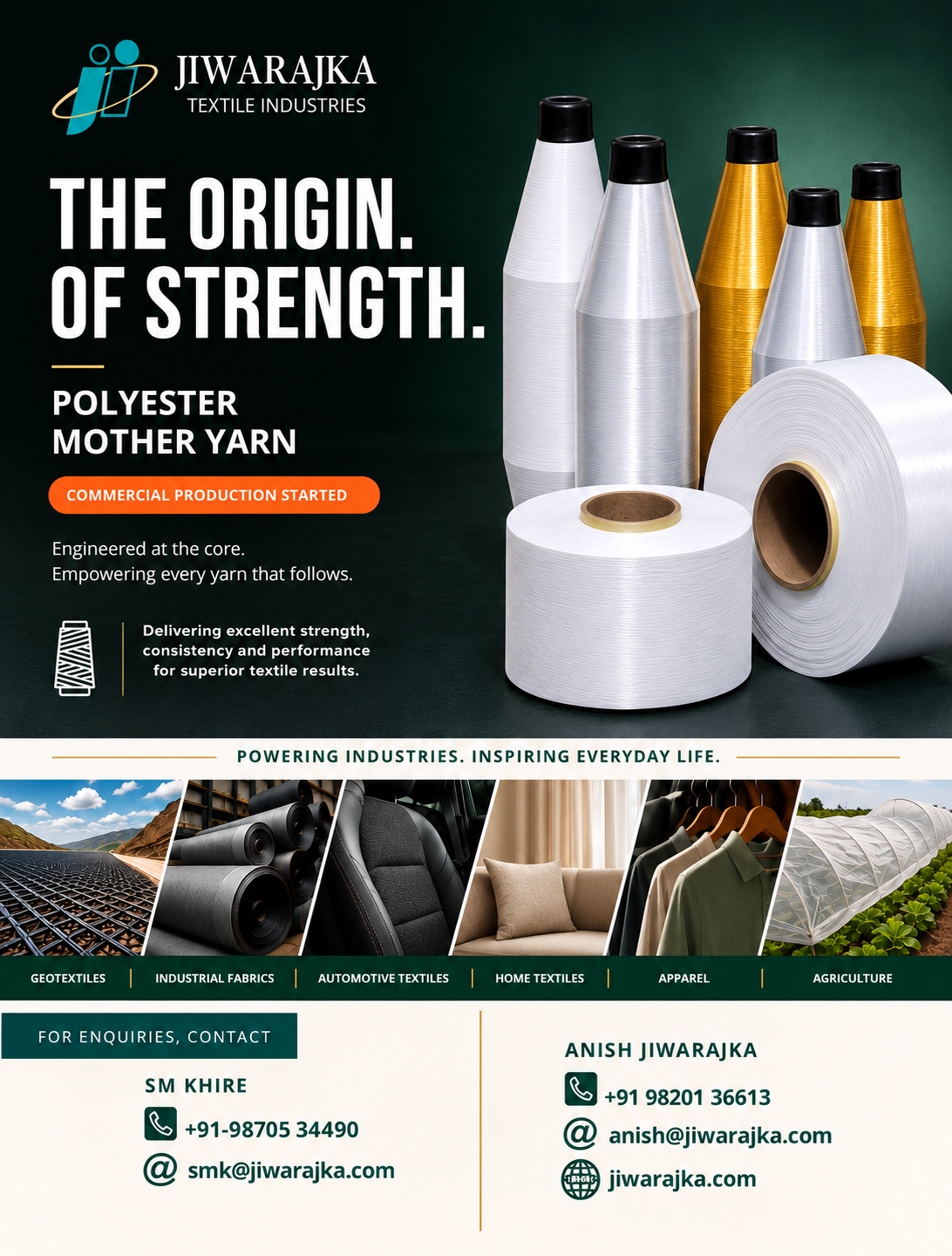
Polyester Mother Yarn is a coarse, high filament count multifilament yarn made from polyethylene terephthalate (PET), produced as an intermediate raw material rather than a finished product. Unlike yarns meant to go straight onto a loom or knitting machine, Mother Yarn exists mainly to be broken down further: split into finer filament groups, twisted into plied yarns, texturized, or converted into monofilament strands for specialised applications.
In practical terms, Mother Yarn typically falls in the 500 to 2,000 denier range, with filament counts anywhere from around 100 to over 1,000 depending on the end use. Tenacity generally sits between 4.0 and 6.0 grams per denier, with elongation at break ranging from roughly 20 to 80 percent depending on how far the yarn has been drawn. It is manufactured in bright, semi-dull, and full dull lustre, and increasingly in variants made partly or wholly from recycled PET (rPET) to meet sustainability requirements from brands and regulators alike.
As a textile raw material, Mother Yarn sits upstream of almost the entire polyester value chain. Sewing thread, embroidery thread, monofilament, industrial fabrics, and a large share of technical textiles all trace back to a mother yarn base at some stage of production.
Why It Is Called "Mother" Yarn
The name is more literal than it sounds. In yarn manufacturing, a single mother yarn tow is drawn thick and strong specifically so that it can be divided into multiple finer yarns later, much the way a single length of rope can be unwound into several thinner strands. Once produced, that base yarn is split into individual filament groups or drawn down further into finer counts, each of which can go on to serve a completely different application. One split might end up in a sewing thread. Another might be twisted into an embroidery yarn. A third might be converted into a fine monofilament for filtration fabric.
Because a single parent lot can give rise to so many "offspring" yarns, the trade settled on the term Mother Yarn, sometimes also called Parent Yarn. It is also why so much rides on getting the parent lot right. A flaw introduced at this stage does not stay contained to one product; it propagates across every yarn that gets split or drawn from that batch.
How Polyester Mother Yarn Is Manufactured
Mother Yarn production begins the same way most polyester filament yarn does, with PET chips (virgin or recycled) melted and extruded through a spinneret to form continuous filaments. From there, the process typically follows three broad stages:
List of Services
-
Melt spinningList Item 1
Molten PET is extruded through a spinneret with hundreds to over a thousand fine capillaries, then cooled and collected as a bundle of continuous filaments. Because Mother Yarn needs a high filament count and a coarse overall denier, spinneret design and cooling airflow are calibrated to keep every individual filament within a tight denier tolerance.
-
Drawing and heat settingList Item 2
The as-spun yarn is drawn (stretched) to align the polymer chains, which builds tenacity and reduces elongation. Depending on the intended downstream use, Mother Yarn may be partially or fully drawn, and heat set to stabilise shrinkage before it leaves the plant.
-
Finishing and windingList Item 3
An oil or finish is applied to control friction for whatever comes next, whether that is high-speed splitting, twisting, or texturizing. The yarn is then wound onto packages sized for the buyer's downstream machinery.
Throughout this process, a handful of quality checkpoints matter far more than they might appear to from the outside:
| Parameter | Typical Range | Why it matters downstream |
|---|---|---|
| Denier | 500 to 2,000 | Determines how many finer yarns can be split from one lot and their target counts |
| Filament count | 100 to 1,000+ | Affects hand feel, splitting precision, and monofilament yield |
| Tenacity | 4.0 to 6.0 g/denier | Governs strength retention through twisting, weaving, and end-use stress |
| Elongation at break | 20 to 80 percent | Influences runnability on high-speed machines and fabric dimensional behaviour |
| Lustre | Bright, semi-dull, full dull | Sets the visual finish of the eventual fabric or thread |
Why Mother Yarn Quality Determines Every Downstream Process
This is the part of the story that rarely gets told outside mill floors, but it is the reason experienced buyers scrutinise Mother Yarn so closely before placing an order.
- Denier and filament uniformity decide splitting accuracy. When a mother yarn lot is divided into finer yarns, any inconsistency in the parent denier shows up as count variation in every yarn split from it. A weaving or knitting mill working off an uneven feedstock will see that unevenness resurface as thin and thick places in the finished fabric, sometimes only visible after dyeing.
- Tenacity and elongation set the ceiling for everything after. Twisting, texturizing, warping, and weaving all put mechanical stress on a yarn. A mother yarn with inconsistent tenacity will break more often on high-speed machines, causing downtime and wastage well before the fabric stage. Once fabric is formed, elongation behaviour also affects how it responds to tension during finishing and how it performs in end use, whether that is a seat belt webbing or a lightweight lining fabric.
- Evenness (U%) governs dye uptake. Fabric woven or knitted from unevenly drawn yarn tends to take dye unevenly too, producing barré or streaking that only becomes visible at the very end of the value chain, when it is the most expensive stage to fix.
- Shrinkage control protects dimensional stability. If a mother yarn's shrinkage behaviour is not properly stabilised during heat setting, fabric made from it can shrink or distort unpredictably after washing or heat exposure, a defect that surfaces long after the yarn has changed hands several times.
- Oiling and finish affect runnability. The right finish reduces friction and static during splitting, twisting, and texturizing. Get this wrong and a mill sees more filament breaks, more fuzz, and lower machine efficiency, even if the yarn's core mechanical properties are fine.
Put simply, Mother Yarn is the point in the value chain where a defect is cheapest to catch and most expensive to ignore. This is exactly why manufacturers with strong in-house testing, from denier and tenacity checks to evenness testing, are able to prevent problems that would otherwise resurface three or four processing stages later, in someone else's factory.
Applications of Polyester Mother Yarn Across Industries
Because it is a precursor rather than a finished yarn, Mother Yarn quietly underpins a wide range of end products:
List of Services
-
Sewing and embroidery threadList Item 1
where mother yarn is split and twisted into fine, high-strength plied yarns used across garment manufacturing and decorative stitching
-
Woven and knitted apparel fabricsList Item 2
where finer yarns drawn from a mother yarn base are used for shirting, suiting, and knitwear.
-
Home textilesList Item 3
including curtains, cushions, and bed linen fabrics.
-
Industrial and technical textilesList Item 4
such as conveyor belting reinforcement, tarpaulins, and filtration fabrics
-
Automotive textiles
including seat cover fabrics and upholstery.
-
Monofilament products
Such as nets, geotextiles, and agricultural mesh, where mother yarn serves as the feedstock for further drawing into single-strand filament
-
Packaging and strapping
Where high-tenacity variants are used for durability under load.
This breadth of application is precisely why Polyester Mother Yarn is treated as a core textile raw material rather than a niche product. A single manufacturing lot can, in principle, feed apparel, industrial, and technical textile customers simultaneously, provided the base quality is consistent enough to support all three.
Polyester Mother Yarn vs POY, FDY, and DTY
The terminology around polyester filament yarn can be confusing, partly because several yarn types share a similar starting point. Here is how Mother Yarn compares with the other common polyester yarn categories.
| Yarn type | What it is | Typical use |
|---|---|---|
| POY (Partially Oriented Yarn) | Yarn spun at high speed but not yet drawn; an intermediate stage in itself | Feedstock for texturizing into DTY |
| FDY (Fully Drawn Yarn) | Spun and drawn in one continuous process, ready to use | Direct weaving, knitting, and twisting |
| DTY (Draw Textured Yarn) | POY that has been drawn and texturized for bulk and stretch | Knitwear, apparel needing stretch or bulk |
| Mother Yarn | A coarse, high filament count multifilament yarn produced specifically to be split or drawn into finer yarns | Sewing thread, embroidery thread, monofilament, technical textiles |
The distinction that trips people up most often is between Mother Yarn and POY. Both are intermediate products, but POY is an early-stage yarn on its way to becoming DTY through texturizing, while Mother Yarn is a deliberately coarse, high filament yarn engineered to be split into multiple finer yarns for entirely different downstream products. They serve different purposes even though both sit upstream of a finished yarn.
Market Outlook: Why Demand for Polyester Mother Yarn Is Rising
The case for Polyester Mother Yarn is not only technical, it is also a market story, and one that is currently moving in India's favour.
India's polyester filament yarn market stood at roughly 2.53 million metric tonnes in 2024 and is projected to cross 3.06 million metric tonnes by 2030, growing at a compound annual growth rate of around 3.24 percent, according to TechSci Research. Polyester already accounts for close to 77 to 80 percent of India's total synthetic fibre production, making it by far the dominant fibre in the country's man-made fibre basket. Globally, polyester yarn demand is following a similar trajectory, with several market research estimates placing the global polyester yarn market in the range of USD 45 to 50 billion in 2025 and projecting growth at a compound annual rate of roughly 5 to 6 percent through the early 2030s, driven by apparel, home textiles, and a fast-growing industrial and technical textile segment.
Government policy is reinforcing this shift. The Production Linked Incentive (PLI) Scheme for Textiles, notified in September 2021 specifically to promote man-made fibre apparel, fabrics, and technical textile products, has approved 170 companies with investments of over Rs 8,117 crore and more than 33,400 new jobs created as of March 2026, with 225 products now notified across the MMF and technical textiles segments. Alongside it, the National Technical Textiles Mission carries a dedicated budget of Rs 256 crore for the current financial year, including grants aimed at startups developing new technical textile applications. India's textile and apparel exports, including handicrafts, rose to roughly Rs 3.25 lakh crore in FY 2025-26.
All of this sits under the government's broader 5F vision for the textile sector, Farm to Fibre to Factory to Fashion to Foreign, which has become a recurring theme at industry platforms such as Bharat Tex. For manufacturers positioned upstream in the value chain, particularly those investing in technical textile grade products like Industrial Yarn (IDY) and Polyester Mother Yarn, this policy push translates directly into rising demand from converters, exporters, and technical textile producers who need a dependable domestic textile raw material supply rather than relying on imports.
What to Look for in a Polyester Mother Yarn Manufacturer
Because so much of a finished product's quality is set at the mother yarn stage, choosing the right supplier matters more here than it does for many other textile inputs. A few things worth checking before placing an order:
- Batch-to-batch consistency. Ask for test data across multiple lots, not just a single sample certificate. Denier, tenacity, and evenness should hold steady across production runs, not only in a showcase batch.
- Relevant certifications. ISO 9001 (Quality Management), ISO 14001 (Environmental Management), and ISO 45001 (Occupational Health and Safety) indicate a manufacturer runs disciplined, audited processes. OEKO-TEX Standard 100 certification confirms the yarn has been tested for harmful substances, which matters increasingly for apparel and home textile buyers. If recycled content is part of the offering, look for GRS (Global Recycled Standard) certification to verify traceability.
- In-house testing and R&D capability. A manufacturer with its own testing lab and product development function is far more likely to catch and correct quality drift before it reaches you, and to support custom specifications such as UV-resistant, flame-retardant, or high-tenacity grades.
- Production scale and flexibility. Bulk orders need manufacturers with the installed capacity to deliver consistently on schedule, while custom or smaller orders benefit from a manufacturer willing to work on denier, lustre, and colour customisation rather than offering a fixed catalogue only.
- Export experience. A manufacturer with an established export track record and recognitions such as export house status is generally better equipped to handle documentation, quality expectations, and logistics for international buyers.

Frequently Asked Questions
- What is polyester mother yarn used for? It is primarily used as a precursor raw material that gets split, twisted, or drawn into finer yarns for applications including sewing thread, embroidery thread, monofilament, woven and knitted fabrics, and technical textiles such as filtration fabric and industrial webbing.
- What is the difference between mother yarn and monofilament yarn? Mother yarn is a multifilament yarn, meaning it is made up of many individual filaments bundled together, and is often used as feedstock to produce monofilament yarn, which is a single continuous strand drawn to a specific diameter for uses like netting, ropes, and technical fabrics.
- What denier range does polyester mother yarn come in? Most polyester mother yarn falls between 500 and 2,000 denier, with filament counts ranging from around 100 to over 1,000, depending on the finer yarns it is intended to produce.
- Is mother yarn the same as POY? No. Both are intermediate yarns, but POY (Partially Oriented Yarn) is an early-stage yarn typically texturized into DTY, while mother yarn is a coarser, higher filament count yarn engineered specifically to be split or drawn into multiple finer yarns for different downstream products.
- How do I choose a reliable polyester mother yarn manufacturer in India? Look for consistent batch-to-batch testing data, recognised certifications such as ISO 9001, ISO 14001, ISO 45001, and OEKO-TEX Standard 100, in-house R&D and testing capability, adequate production capacity, and a track record of export compliance if you are sourcing internationally.
- Can polyester mother yarn be made from recycled PET? Yes. Recycled PET (rPET) based mother yarn is increasingly available and, when GRS certified, offers verified recycled content for brands and manufacturers working toward sustainability targets.
Polyester Mother Yarn rarely gets the attention finished fabric does, but it is where quality manufacturing actually begins. For textile businesses sourcing sewing thread, technical fabrics, or monofilament products, the consistency of this single raw material has more influence over the final product than almost anything that happens afterward.
To discuss bulk orders, custom specifications, or samples of Jiwarajka's Polyester Mother Yarn range, reach out to the Jiwarajka Textile Industries team directly through jiwarajka.com.